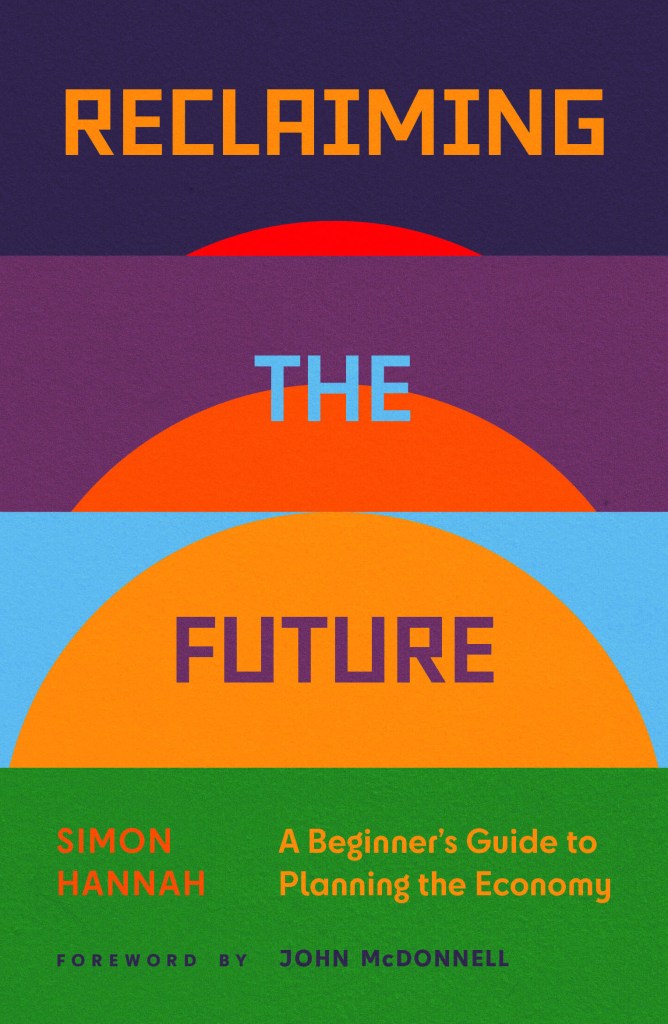
Reclaiming The Future: A Beginners Guide to Planning the Economy – on sale in November 2024

PART I THE FIGHT FOR AN ECOSOCIALIST PLAN

  1. 1  How Does Capitalism Work?
  2. 2  A Living Movement for Socialism
  3. 3  The Post-capitalist Society

PART II DEBATES

  1. 4  Arguments Against Socialism: Human Nature and Knowledge
  2. 5  Debates Within Socialism: Automation, UBI and
    Market Socialism
  3. 6  Green New Deal, Ecosocialism and Degrowth

Conclusion

Everything you see in our town, greenhouses, livestock, all shared. Collective ownership … This is a commune. We’re communists.

—Maria, The Last of Us

My next book is out in November 2024! Let’s reclaim the future from the oppressive forces of the far right and the death cult ecocide of the capitalists. Let’s build a world based on collective ownership, social planning and participatory democracy to establish radical abundance for us all.

This book has been around three years in the research and writing. It is based on a passionately held belief of mine that a core part of the radical left project has to be inspiring people for a better world, one free of exploitation and oppression. The reluctance to even really engage in a creative debate of what post-captialist might look like is a serious weakness of ours. Marx might have been reluctant to write ‘cook books for the future’ but we have the experience of the 20th century, and the apparent catastrophic failure of ‘communism’. Unless we can explain what will be different and how we can build it – or at least open a discussion about that – then we will not win. And with the climate crisis accelerating beyond control – we cannot afford to fail again.

You can pre-order online here

Continue reading Reclaiming The Future: A Beginners Guide to Planning the Economy – on sale in November 2024

Mark Twain – In defence of terror

“THERE were two “Reigns of Terror,” if we would but remember it and consider it; the one wrought murder in hot passion, the other in heartless cold blood; the one lasted mere months, the other had lasted a thousand years; the one inflicted death upon ten thousand persons, the other upon a hundred millions; but our shudders are all for the “horrors” of the minor Terror, the momentary Terror, so to speak; whereas, what is the horror of swift death by the axe, compared with lifelong death from hunger, cold, insult, cruelty, and heart-break? What is swift death by lightning compared with death by slow fire at the stake? A city cemetery could contain the coffins filled by that brief Terror which we have all been so diligently taught to shiver at and mourn over; but all France could hardly contain the coffins filled by that older and real Terror—that unspeakably bitter and awful Terror which none of us has been taught to see in its vastness or pity as it deserves.”

The US right have no clue…

The US right have lost their collective wits. Their political compass is all out of whack. Some of them actually believe that the Democrats are communists. They have gone so far off the deep end that they can’t tell the difference between liberalism and Leninism.

It’s a sign of the hollowing out of bourgeois democracy, of the destruction of meaning in modern political discussions.

Revolutions and civil wars

Occasionally you see socialists accommodating to pacifist tendencies in the working class by implying that a revolution is probably just like a really big demo, or maybe a general strike, and then the government collapses and then the working class forms a new government. They question of force sometimes is referred to only in the fact that there might be some clashes with the police perhaps.

In the Syrian revolution some people got squeamish when it turned into a civil war, preferring the mass pro-democracy protests at the start and then becoming all shy and moderate about it when Assad sent in the security forces to start killing people.

Trotsky makes the comment during the Russian civil war after 1917 that; “The international proletariat put before itself as its problem the conquest of power. Independently of whether civil war, “generally,” belongs to the inevitable attributes of revolution, “generally,” this fact remains unquestioned – that the advance of the proletariat, at any rate in Russia, Germany, and parts of former Austro-Hungary, took the form of an intense civil war not only on internal but also on external fronts. If the waging of war is not the strong side of the proletariat, while the workers’ International is suited only for peaceful epochs, then we may as well erect a cross over the revolution and over socialism; for the waging of war is a fairly strong side of the capitalist State, which without a war will not admit the workers to supremacy.” 

The fact if you cannot point to a revolution that does not turn into some kind of civil war – the same is true of the English Revolution between 1642–1651 of course. Ultimately in any significant social struggle between the classes the question of force decides. But the question of politics is also decisive. In any struggle for political power, the insurgent forces have to be able to articulate a programme that encompasses the needs of the broadest masses and offers incentives and gains for why people should support the revolution. Likewise the forces of the status quo fight to win in the field of politics, to convince the people that the way things are should ultimately be preserved, while usually offering wild concessions that they later ignore and tear up.

Anyone who says there is a completely peaceful road to socialism is either wilfully naive about the levels of violence that the capitalist class will inflict to stay in power, or they hugely over estimate the democratic sensibilities of those who currently run society, as if they would give up everything because they lost an election?

But revolutionaries know that winning political hegemony is crucial to winning power. The more you can win over the working class and popular progressive forces then the more the revolution itself will be a relatively bloodless affair. But the greater the forces of reaction, the forces of bourgeois order… the more difficult the road ahead.

Alexandra Kollontai: when it comes to women’s rights, class matters

What is the aim of the feminists? Their aim is to achieve the same power, the same rights within capitalist society as those possessed now by their husbands, fathers and brothers. What is the aim of the women workers? Their aim is to abolish all privileges deriving from birth or wealth. For the women worker it is a matter of indifference who is the ‘master’ a man or woman. Together with the whole of her class, she can ease her position as a worker.

Feminists demand equal rights always and everywhere. Women workers reply: we demand rights for every citizen, man and woman but we are not prepared to forget that we are not only workers and citizens, but also mothers! And as mothers, as women who give birth to the future, we demand special concern for ourselves and our children, special protection from the state and society.

The feminists are striving to acquire political rights. However, here too our paths separate. For bourgeois women political rights are simply a means allowing them to make their way more conveniently and more securely in a world founded on the exploitation of the working people. For women workers, political rights are a step along the rocky and difficult path that leads to the desired kingdom of labour.

The paths pursued by women workers and bourgeois suffragettes have long since separated. There is too great a difference between the objectives that life has put before them. There is too great a contradiction between the interests of the women worker and the lady proprietress, between the servant and her mistress. There are not and cannot be any points of contact, conciliation or convergence between them.
— Alexandra Kollontai: Women’s Day published in Pravda one week before the first ever celebration in Russia of the Day of International Solidarity among the Female Proletariat on 23 February (8 March), 1913.

Who steals the common from off the goose

The law locks up the man or woman
Who steals the goose from off the common
But leaves the greater villain loose
Who steals the common from off the goose

The law demands that we atone
When we take things we do not own
But leaves the lords and ladies fine
Who take things that are yours and mine

The poor and wretched don’t escape
If they conspire the law to break
This must be so but they endure
Those who conspire to make the law

The law locks up the man or woman
Who steals the goose from off the common
And geese will still a common lack
Till they go and steal it back

The capitalist class and revolution

In 1879 Carlo Cafiero did a summary of Capital and Marx’s ideas for Italian readers. In the conclusion he wrote a brilliant and evocative account of the nature of revolution and why the capitalist class invokes it but then pulls back and turns on the very workers it whipped up for its cause. Worth reading and thinking on.

——

The disease is sweeping. It’s been a long time that the workers of the civilized world have known it; certainly not all, but a great number, and these are already preparing the means of action to destroy it.

They have considered these:

I. That the first source of every human oppression and exploitation is private property;

II. That the emancipation of workers (human emancipation) will not be founded upon a new class rule, but upon the end of all class privileges and monopolies and upon the equality of rights and duties;

III. That the cause of labor, the cause of humanity, does not have borders;

IV. That the emancipation of workers must be done at the hands of the workers themselves.

And so a mighty voice has shouted: “Workers of the world, unite! No more rights without duties, no more duties without rights! Revolution!”

But the revolution demanded by the workers is not a revolution of pretext, it is not the practical method of a moment to reach a given aim. Even the bourgeoisie, like so many others, demanded the revolution one day; but only to supplant the nobility, and to substitute for the feudal system of serfdom that more refined and cruel system of wage-work. And they call this progress and civility! In fact every day we help the ridiculous show of the bourgeoisie, who go babbling the word revolution, with the sole aim of being able to jump up onto the maypole tree, and to grab power. The workers’ revolution is the revolution for the revolution.

The word “Revolution”, taken in its largest and truest sense, means turning, transformation, change. As such, revolution is the soul of all infinite mass. In fact, all in nature changes, but nothing is created and nothing is destroyed, as chemistry shows us. Mass, remaining always in the same quantity, can change form in infinite ways. When mass loses its old form and acquires a new one, it passes from the old life, in which it dies, to the new life, in which it is born. When our spinner, using a familiar example for us, transformed the 10 kilos of cotton into 10 kilos of thread, what else came about if not the death of 10 kilos of mass in the form of cotton, and at their birth in the form of thread? And when the weaver transforms the thread into cloth, what else will come about if not the matter passing from a life of string unto a life of cloth, as it has passed already before from a life of cotton unto a life of thread? Mass, therefore, passing from one turn of life to another, lives ever-changing, transforming, revolutionizing.

Now, if revolution is the law of nature, which is all, it must necessarily also be the law of humanity, which is a part of nature. But you have a few men upon the Earth who do not think this is so, or, rather, who close their eyes so as not to see and their ears so as not to hear.

“Yes, it is true,” I hear shouting from a bourgeois, “the natural law, the revolution that you claim, is the absolute regulator of human relations. The fault of all the oppressions, of all the exploitations, of all the tears and all of the massacres they are caused by, one must justly attribute to this inexorable law that imposes revolution upon us, that is, continuous transformation, the struggle for existence, the absorption of the weaker made stronger, the sacrifice of the less perfect types for the development of the more perfect types. If hundreds of workers are burned up for the wellbeing of only one bourgeois, that happens without the slightest fault of this, that is indeed sad and dreary, but only by the decree of natural law, of revolution.”

If one speaks in such a way, the workers ask nothing better, who wish for transformation, the struggle for existence, revolution, under the same natural law, the ones indeed preparing themselves to be stronger, to sacrifice all monstrous and parasitic plants for the complete and flourishing development of the most beautiful human tree, whole and perfect, which it must be, in all of the wholeness of its human character.

But the bourgeoisie are too fearful and pious to be able to appeal to the natural law of revolution. They have been able to invoke it in a moment of drunkenness; but, afterwards back to their normal selves, their accounts done, and having found that their doings were nice and pleasing, they gave themselves to shouting until they couldn’t anymore: “Order, religion, family, property, conservation!” It is so that, after having arrived at conquering, with massacre, fire and robbery, the role of the dominators and exploiters of the human race, they believe that they can stop the course of revolution; without realizing, in their stupidity, that they can do nothing else, with their efforts, than to make horrible troubles for humanity, and as a consequence for themselves, with the sudden explosions of the revolutionary force they madly repress.

The revolution, the material obstacles that oppose it shot down, and left free in its path, will by itself be enough to create the most perfect balance, order, peace, and the most complete happiness between people, because people, in their free development, will not proceed in the manner of wild animals but in the manner of human beings, eminently reasonable and civil, who understand that no person can be truly free and happy if they are not within the common liberty and happiness of all of humanity. No more rights without duties, no more duties without right. Therefore no more struggle for existence between people, but struggle for existence of all people with nature, by appropriating from the great sum of natural forces for the benefit of all of humanity.

The disease known, it is easy to know the remedy: revolution for the revolution.

But how will the workers be able to restore the course of the revolution?

This is not the place for a revolutionary program, already elaborated and published long ago elsewhere in other books; I confine myself to conclude, replying with the words taken from the lips of a worker and placed in epigraph to this volume: “The worker has made everything; and the worker can destroy everything, because he can rebuild everything


“Shoot them in the leg” – the death rattle of liberalism

You could not make Biden up.
It is a nation wide urban uprising against police violence and the liberal response is “shoot them in the leg instead of the heart.”
Ignoring the fact that there is no thing as a ‘shoot to wound’ – law enforcement are trained to shoot to kill and even if you do ‘shoot to wound’ you might hit an artery or some other complication that ends up killing someone – this is the most brilliant spectacular example of liberalism I have seen in my lifetime.
Don’t question the structures. Don’t question the institutions. Don’t analyse power. Don’t understand the righteous anger of generations rising up against oppression.
No. Instead we get ‘officer, be a nice guy and only shoot them in the leg.’
Ignoring the fact that some of the most disgusting acts of violence and murder – including the one against George Floyd – have got NOTHING to do with being shot. The police don’t need to shoot you in the heart to kill you, if you are a black American, or poor or someone they hate they can slowly strangle you to death whilst people watch on.
And Biden is the choice for the liberals to go up against Trump.

What do you think of Momentum democracy? – It would be a nice idea

Everyone is doing the democracy dance in Momentum. Even the old guard leadership are making some vague noises that maybe somehow things might need to kind of be different. Let’s look at some previous ‘nice ideas’ that never happened.

Continue reading What do you think of Momentum democracy? – It would be a nice idea